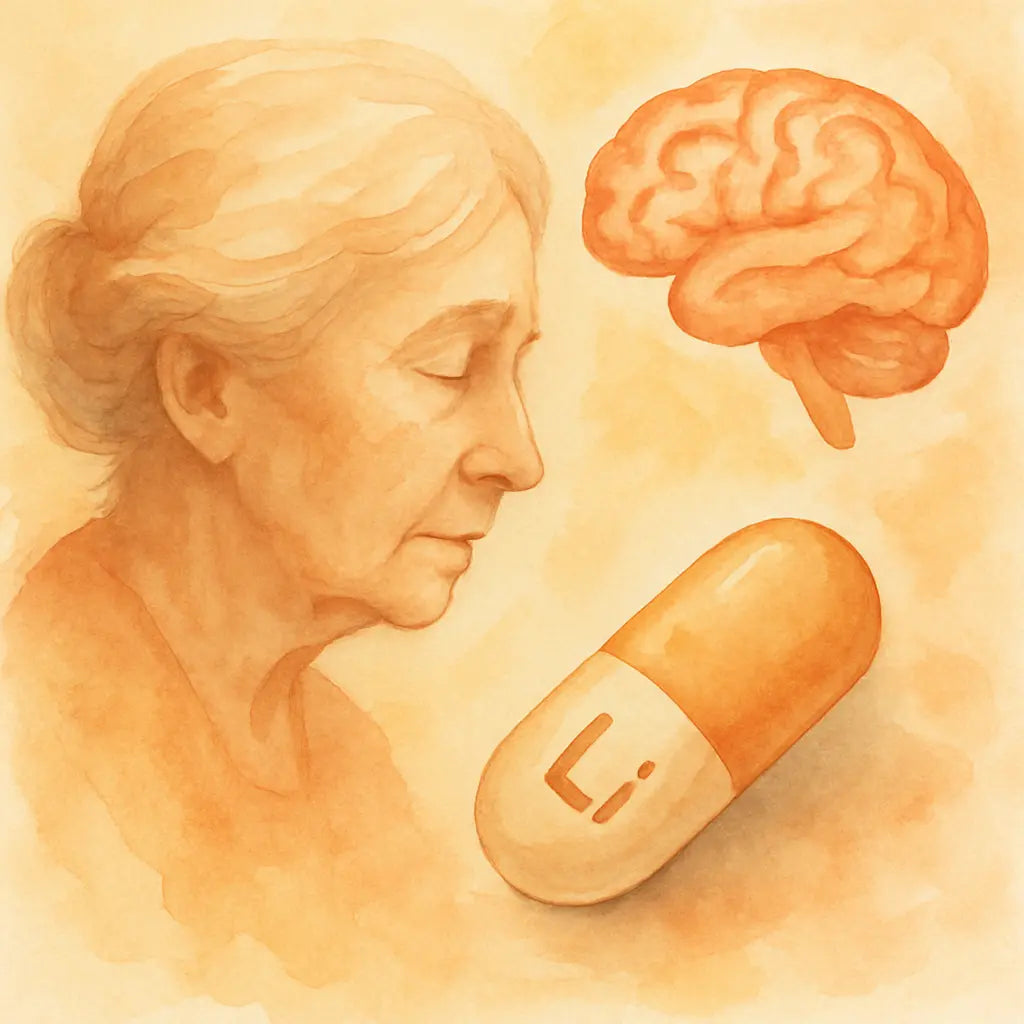
The search for solutions to Alzheimer's disease has led science down complex and often fruitless paths. However, an emerging line of research suggests that the answer may lie, in part, in a simple yet fundamental element: a mineral. This article explores the growing evidence linking lithium deficiency to cognitive decline and the development of Alzheimer's disease, revealing how an essential micronutrient could be key to protecting long-term brain health.
Context: What is Lithium and Why Does It Matter?
Lithium is a chemical element, a light alkali metal, primarily known for its use in pharmacological doses to treat bipolar disorder. However, beyond this clinical use, lithium is also a trace mineral naturally present in water and certain foods. Its function in the body at low levels has been less studied, but recent research is shedding light on its crucial role as a neuroprotective and mood-regulating agent at physiological doses.
The central hypothesis is that insufficient levels of this mineral in the brain could be a significant risk factor for the development of neurodegenerative diseases. Unlike high psychiatric doses, Alzheimer's prevention research focuses on "microdoses," or trace amounts—thousands of times smaller—that the body needs to maintain optimal brain function.
Key Concepts: Lithium, Brain Plaques and Alzheimer's
To understand the connection, it is essential to understand the mechanisms involved in Alzheimer's disease. One of the hallmarks of this pathology is the accumulation of beta-amyloid protein plaques in the brain. These plaques are sticky clumps of protein that form between neurons, disrupting cell communication, causing inflammation, and ultimately leading to the death of brain cells. This process underlies memory loss and progressive cognitive decline.
Research suggests that lithium plays a direct role in this process. Studies in both animal models and humans have shown that the presence of lithium in the brain can inhibit the formation of these plaques and reduce existing ones. The leading theory posits that low levels of the mineral facilitate the accumulation of these toxic proteins, while adequate supplementation could halt or even reverse this damage.
Scientific Evidence Linking Lithium Deficiency to Alzheimer's
The scientific community has moved from correlation to causation thanks to rigorous studies. Initially, observational research in humans showed a clear pattern: the brains of people with Alzheimer's or mild cognitive impairment had significantly lower lithium levels compared to the brains of healthy individuals.
To establish a cause-and-effect relationship, animal models were used. In experiments with mice genetically predisposed to developing an Alzheimer's-like condition, the results were revealing:
- Lithium Deficiency: The group of mice on a lithium-deficient diet developed a significantly greater amount of brain plaques. In addition, their performance on cognitive tests was markedly worse.
- Lithium Supplementation: When these same mice were given a lithium supplement, a dramatic reduction in the number of amyloid plaques and a substantial improvement in their brain function and memory were observed.
These findings strongly suggest that lithium deficiency is not merely a consequence of the disease, but an active contributing factor to its development. Supplementation, therefore, emerges as a promising preventive strategy.
Practical Applications: Supplementation and Correct Doses
Lithium supplementation for brain health is a field that requires precision and expertise, especially regarding chemical form and dosage. Not all forms of lithium act the same way in the brain affected by Alzheimer's disease.
Organic vs. Inorganic Salts: A Crucial Difference
A key finding is that amyloid protein plaques appear to "sequester" lithium, preventing it from reaching neurons where it is needed. This phenomenon is more pronounced with certain forms of the mineral. Research has identified that:
- Inorganic Salts (Chloride, Carbonate): These are less effective at combating plaque, as they are more susceptible to being trapped by it.
- Organic Salts: These demonstrate a greater capacity to avoid this sequestration and reach brain cells. Studies indicate that organic lithium salts not only prevent, but can achieve a "significant reversal" of the brain degradation associated with Alzheimer's.
Practical Tip: The Dose is Everything
It is crucial not to confuse the lithium doses used for cognitive prevention with the pharmacological doses used in psychiatry. The difference is enormous:
- Dosage for Bipolar Disorder: Measured in milligrams (mg).
- Cognitive Prevention Dosage: Measured in micrograms (mcg), an amount up to 1,000 times smaller.
Human studies that have shown positive results in reducing cognitive decline have used trace doses, generally in the range of 300 to 400 micrograms of elemental lithium per day.
Frequently Asked Questions (FAQ)
- Does this mean that taking lithium can cure Alzheimer's?
- Current evidence points to lithium as a powerful preventative and potentially restorative tool. Animal studies show a reversal of plaque buildup, and human trials are promising for halting further deterioration. However, it should not be considered a guaranteed "cure," but rather a preventative and supportive strategy with a solid scientific basis.
- Is it safe to take lithium supplements?
- At the microgram doses recommended for cognitive health (300-400 mcg), lithium is considered a safe trace mineral, well below the levels that require medical supervision. Higher doses (milligrams) used for psychiatric conditions are the ones that carry risks and must be managed by a healthcare professional.
- What type of lithium supplement should I look for?
- Based on research, organic lithium salts, such as lithium orotate, are preferable to inorganic ones (carbonate, chloride) because they appear to have better brain bioavailability and are less likely to be inactivated by amyloid plaques.
- If my lithium levels are low, does that mean I will develop Alzheimer's?
- Lithium deficiency is a risk factor, not a death sentence. As with other health conditions, the development of Alzheimer's disease is multifactorial. However, correcting this mineral deficiency is a logical and evidence-based step to reduce risk and protect brain function.
Conclusion: A New Horizon in Cognitive Prevention
The link between lithium deficiency and Alzheimer's disease represents a paradigm shift, suggesting that neurodegeneration may be influenced by our micronutrient balance. The accumulating evidence is compelling: a deficiency of this trace mineral in the brain is directly linked to an increased risk of cognitive decline and the formation of amyloid plaques. Supplementation with low doses and organic forms of lithium has not only been shown to halt this process in laboratory models but also to improve brain function.
This approach opens the door to accessible, low-risk preventative strategies. Ensuring adequate lithium levels could become standard practice for maintaining long-term brain health, offering tangible hope in the fight against one of the most devastating diseases of our time. Exploring additional resources and consulting with knowledgeable professionals is the next logical step for anyone interested in proactively protecting their cognitive function.